Replacing a water heater is one of the few moments in home ownership when switching from a tank to a tankless system is a practical option. The old unit needs to come out regardless, and the labor for a tankless installation is not much more than for a tank replacement if the gas supply and venting are already compatible. But for Maricopa homeowners on Global Water Resources supply, the tank-versus-tankless decision has a dimension that most general guides overlook: Maricopa's 25 to 35 GPG hard water requires significantly more frequent descaling of tankless units than in soft-water markets, which affects long-term cost and maintenance commitment in ways that a Phoenix metro guide does not address.
How each type works
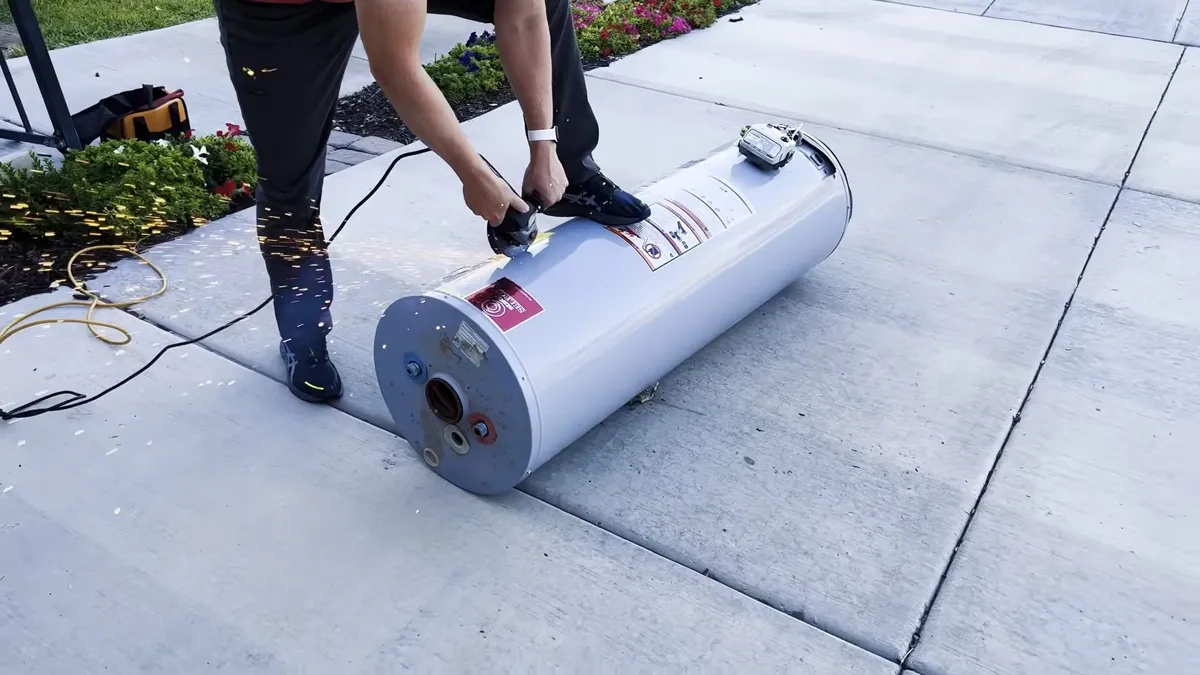
A tank water heater stores a reservoir of heated water, typically 40 to 80 gallons, at a set temperature around the clock. When a fixture calls for hot water, it draws from the stored reservoir. The tank then refills with cold supply water and reheats. The energy cost of keeping a tank at temperature continuously, even when no hot water is being used, is the tank unit's main efficiency disadvantage, called standby heat loss.
A tankless water heater has no storage tank. When a fixture opens, cold water flows through a compact heat exchanger, where high-output gas burners or electric elements instantly heat the water to the target temperature. The unit only runs when hot water is actively being demanded, eliminating standby heat loss. The tradeoff is that the heat exchanger must heat water at the full flow rate of the fixture in real time, which requires significantly higher BTU output than a tank unit, and the heat exchanger is the component most affected by Maricopa's hard water.
The Maricopa variable: hard water descaling
In a tank water heater, hard water minerals settle to the bottom of the tank as calcium carbonate sediment. This is damaging but manageable through annual flushing. In a tankless unit, the minerals do not have a tank floor to settle onto. Instead, they deposit directly on the heat exchanger fins and tubes as scale, because the water in the narrow heat exchanger channels reaches mineral-precipitation temperatures at the point of maximum heat transfer. The heat exchanger in a tankless unit is both more efficient and more vulnerable to scale than a tank bottom.
At Maricopa's 25 to 35 GPG, scale accumulates in a tankless heat exchanger fast enough that descaling service is required every 12 to 18 months without a water softener. Each descaling appointment costs $150 to $300 and takes 45 to 90 minutes. Over 10 years, that is 6 to 8 descaling services totaling $900 to $2,400 in maintenance costs, not counting the increased repair risk from heat exchanger damage if a descaling cycle is missed.
With a properly sized water softener upstream of a tankless unit, the softened water entering the heat exchanger is at 0 to 3 GPG rather than 25 to 35 GPG. Scale accumulation drops dramatically, and descaling intervals extend to every 24 to 36 months. Over 10 years, that is 3 to 4 descaling services at $450 to $1,200 total. For any Maricopa homeowner seriously considering a tankless unit, installing a whole-home water softener at the same time is not optional. It is the condition that makes the economics work.
Gas line capacity: the first check before a tankless decision
Tankless water heaters require much higher gas flow rates than tank units. A standard 50-gallon tank water heater operates at 36,000 to 50,000 BTU per hour. A whole-home tankless unit sized for a 3-to-4-bathroom Maricopa home typically requires 180,000 to 199,000 BTU per hour. The existing residential gas line, usually 3/4 inch in diameter, may or may not have sufficient capacity to deliver that flow rate depending on the line length from the meter and the total connected gas load on the system (range, dryer, outdoor kitchen, pool heater).
A gas line capacity assessment is the first step in any Maricopa tankless installation evaluation. If the existing line cannot support the required BTU, upgrading to a 1-inch or larger gas line adds $400 to $1,200 to the installation cost. This must be factored into the total cost comparison between tankless and tank before a decision is made. We perform the capacity check as part of the initial assessment for any tankless installation inquiry.
The right candidate for tankless in Maricopa
Tankless water heaters deliver the best value in Maricopa for households with specific characteristics: high simultaneous hot water demand (multiple bathrooms running at once), an existing or planned whole-home water softener, a gas line confirmed to have adequate capacity, and a household that values continuous hot water availability over the lowest upfront installation cost.
Province active adult residents with two full bathrooms and regular use of both simultaneously are good candidates. Large Rancho El Dorado homes with 4 or more bathrooms and high daily hot water volume are also appropriate. In both cases, the pairing with a water softener is essential for Maricopa's water conditions.
The right candidate to stay with a tank in Maricopa
A tank water heater remains the better choice for Maricopa homeowners who want the lowest upfront cost, who do not have or plan to install a water softener, who have a gas line that cannot support tankless BTU requirements without upgrading, or whose household hot water demand is moderate and not concurrent across multiple bathrooms. For these households, a properly sized and maintained tank unit on GWR supply, serviced annually with sediment flushing and anode rod inspection, provides reliable service for 8 to 10 years.
10-year cost comparison for a Maricopa 4-person household
| Cost Category | 50-Gal Tank Unit | Tankless (no softener) | Tankless + Softener |
|---|---|---|---|
| Installation | $900 – $1,800 | $2,000 – $3,500 | $3,200 – $5,000 |
| Annual energy cost | Higher (standby loss) | Lower (on-demand) | Lower (on-demand) |
| 10-yr energy savings (tank) | Baseline | $800 – $1,200 | $800 – $1,200 |
| Descaling (10 yr) | Annual flush: $100-200/yr | $900 – $2,400 | $450 – $1,200 |
| Appliance protection savings | Minimal without softener | Minimal without softener | Significant across all appliances |
The tankless-plus-softener combination provides the best long-term outcome for most Maricopa households with high hot water demand, but it requires the highest upfront investment. The tank-only path requires the lowest upfront cost but delivers the shortest appliance lifespan in Maricopa's hard water environment. There is no universally right answer; the choice depends on your household's hot water usage, budget, and long-term plans for the home.